Inclusive Education Practices in Islamic Primary Schools: Insights from Planning, Implementation, and Evaluation Stages
Keywords:
Inclusive Education, Pull-Out Model, Special Needs Students, Curriculum Adaptation, Elementary EducationAbstract
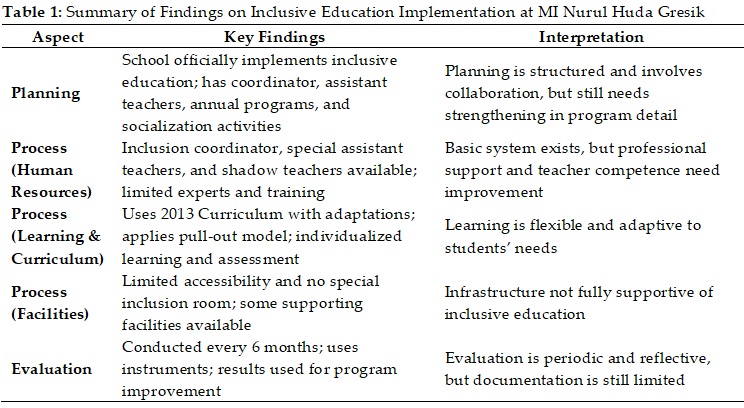
This study aims to analyze the implementation of inclusive education at MI Nurul Huda Gresik, focusing on the stages of planning, implementation, and evaluation. This research employs a qualitative descriptive approach with a case study design. Data were collected through in-depth interviews, direct observation, and documentation involving the principal, classroom teachers, special assistant teachers, and counseling teachers. The data were analyzed using an interactive model, including data reduction, data display, and conclusion drawing. The findings reveal that the school implements inclusive education through a regular classroom model combined with a pull-out approach, allowing students with special needs to learn in inclusive settings while receiving individualized support. In the planning stage, the school develops structured annual programs and establishes an organizational system involving key stakeholders. The implementation process demonstrates adaptive practices in curriculum modification, teaching strategies, and assessment, although challenges remain in terms of limited professional support, insufficient teacher training, and inadequate infrastructure. The evaluation stage is conducted periodically every six months and is used as a basis for program improvement through collaborative decision-making. In conclusion, inclusive education at MI Nurul Huda Gresik has been implemented in a structured and adaptive manner, but further improvements are needed to enhance its effectiveness and sustainability.
References
Abad-Segura, E. (2020). Sustainable management of digital transformation in higher education: Global research trends. Sustainability (Switzerland), 12(5). https://doi.org/10.3390/su12052107
Abbas, A., Marhamah, M., & Rifa’i, A. (2021). The Building of Character Nation Based on Islamic Religion Education in School. Journal of Social Science, 2(2), Article 2. https://doi.org/10.46799/jss.v2i2.106
Abdussalam, A., Anwar, S., & Rahmat, A. T. (2019). The Development of Translation Capability for the Holy Quran of Student of Teacher Candidate for Islamic Religious Education: A Tamyiz Learning and Teaching Strategy. Hayula: Indonesian Journal of Multidisciplinary Islamic Studies, 3(1), 1–16. https://doi.org/10.21009/003.1.01
Achadi, M. W. (2020). Integration of Pancasila Values in Student Books of Islamic Religious Education and Character at High School Level. Jurnal Pendidikan Agama Islam, 17(2), 119–136. https://doi.org/10.14421/jpai.2020.172-02
Agourida, S.-V. (2024). Teacher assistant role on improving inclusion and academic achievement of students with special educational needs in mainstream schools [M]. https://gmwpublic.studenttheses.ub.rug.nl/3694/
Agus, A., Juliadharma, M., & Djamaluddin, M. (2023). Application of the CIPP Model in Evaluation of The Inclusive Education Curriculum in Madrasah Aliyah. Nidhomul Haq : Jurnal Manajemen Pendidikan Islam, 8(1), 31–50. https://doi.org/10.31538/ndh.v8i1.2705
Apriliani, I., Pahrudin, A., Koderi, K., & Syafril, S. (2024). Management of Inclusive Education: An Implementation. Munaddhomah: Jurnal Manajemen Pendidikan Islam, 5(1), 112–125. https://doi.org/10.31538/munaddhomah.v5i1.935
Arif, M., Chapakiya, S., & Masturoh, U. (2025). Trends and Challenges in Islamic Education Learning Media for Early Childhood: A Systematic Literature Review. Pratama Widya: Jurnal Pendidikan Anak Usia Dini, 10(1), 46–64.
Beyene, W. M., Mekonnen, A. T., & Giannoumis, G. A. (2023). Inclusion, access, and accessibility of educational resources in higher education institutions: Exploring the Ethiopian context. International Journal of Inclusive Education, 27(1), 18–34. https://doi.org/10.1080/13603116.2020.1817580
Cipriano, C., Strambler, M. J., Naples, L. H., Ha, C., Kirk, M., Wood, M., Sehgal, K., Zieher, A. K., Eveleigh, A., McCarthy, M., Funaro, M., Ponnock, A., Chow, J. C., & Durlak, J. (2023). The state of evidence for social and emotional learning: A contemporary meta-analysis of universal school-based SEL interventions. Child Development, 94(5), 1181–1204. https://doi.org/10.1111/cdev.13968
Donath, J. L., Lüke, T., Graf, E., Tran, U. S., & Götz, T. (2023). Does Professional Development Effectively Support the Implementation of Inclusive Education? A Meta-Analysis. Educational Psychology Review, 35(1), 30. https://doi.org/10.1007/s10648-023-09752-2
Jardinez, M. J., & Natividad, L. R. (2024). The Advantages and Challenges of Inclusive Education: Striving for Equity in the Classroom. Shanlax International Journal of Education, 12(2), 57–65.
Julien, G. (2024). How Artificial Intelligence (AI) Impacts Inclusive Education. Educational Research and Reviews, 19(6), 95–103.
Kim, D. W., Park, J. S., Sharma, K., Velazquez, A., Li, L., Ostrominski, J. W., Tran, T., Seitter Peréz, R. H., & Shin, J.-H. (2024). Qualitative evaluation of artificial intelligence-generated weight management diet plans. Frontiers in Nutrition, 11. https://doi.org/10.3389/fnut.2024.1374834
Lama, A. V., Zarkasyi, A., Abbasov, R., & Sain, Z. H. (2026). Measure Levels of Social Conformity, Self-Regulation, and Self-Identity Development Among Students. At-Tadzkir: Islamic Education Journal, 5(1), 52–61. https://doi.org/10.59373/attadzkir.v5i1.237
Lambrecht, J., Lenkeit, J., Hartmann, A., Ehlert, A., Knigge, M., & Spörer, N. (2022). The effect of school leadership on implementing inclusive education: How transformational and instructional leadership practices affect individualised education planning. International Journal of Inclusive Education, 26(9), 943–957. https://doi.org/10.1080/13603116.2020.1752825
Lindner, K.-T., & Schwab, S. (2025). Differentiation and individualisation in inclusive education: A systematic review and narrative synthesis. International Journal of Inclusive Education, 29(12), 2199–2219. https://doi.org/10.1080/13603116.2020.1813450
Lindner, K.-T., Schwab, S., Emara, M., & Avramidis, E. (2023). Do teachers favor the inclusion of all students? A systematic review of primary schoolteachers’ attitudes towards inclusive education. European Journal of Special Needs Education, 38(6), 766–787. https://doi.org/10.1080/08856257.2023.2172894
Makoelle, T. M., & Burmistrova, V. (2025). Teacher education and inclusive education in Kazakhstan. International Journal of Inclusive Education, 29(4), 447–463. https://doi.org/10.1080/13603116.2021.1889048
Mendoza, M., & Heymann, J. (2024). Implementation of Inclusive Education: A Systematic Review of Studies of Inclusive Education Interventions in Low- and Lower-Middle-Income Countries. International Journal of Disability, Development and Education, 71(3), 299–316. https://doi.org/10.1080/1034912X.2022.2095359
Mukhammad, M., & Bon, A. T. B. (2026). The Influence of Qur’an Memorization Learning on the Quality of Students’ Qur’an Memorization. At-Tadzkir: Islamic Education Journal, 5(1), 40–51. https://doi.org/10.59373/attadzkir.v5i1.239
Navas-Bonilla, C. del R., Guerra-Arango, J. A., Oviedo-Guado, D. A., & Murillo-Noriega, D. E. (2025). Inclusive education through technology: A systematic review of types, tools and characteristics. Frontiers in Education, 10. https://doi.org/10.3389/feduc.2025.1527851
Nur, M., & Sabur, F. (2025). Development of Teaching Materials and Harmonized Semester Learning Plan for the Aircraft Basic Workshop Theory Course through Learner-Centered Instructional Design in Indonesian Aviation Polytechnics. Journal La Edusci, 6(2), 284–307. https://doi.org/10.37899/journallaedusci.v6i2.2244
Opoku, M. P., & Nketsia, W. (2026). Teachers’ access to professional development in inclusive education: An exploration of the Ghanaian context. International Journal of Inclusive Education, 30(3), 575–596. https://doi.org/10.1080/13603116.2025.2470195
Paramansyah, A., & Rostandi, U. D. (2022). Implementation of Education Management in the Era of Society 5.0. Edukasi Islami: Jurnal Pendidikan Islam, 11(001), 141–152. https://doi.org/10.30868/ei.v11i4.3553
Perkins, M., Roe, J., Vu, B. H., Postma, D., Hickerson, D., McGaughran, J., & Khuat, H. Q. (2024). Simple techniques to bypass GenAI text detectors: Implications for inclusive education. International Journal of Educational Technology in Higher Education, 21(1), 53. https://doi.org/10.1186/s41239-024-00487-w
Rahman, I., & Hakim, L. M. (2024). Development of Creative Economy Based on Local Wisdom in the Era of Digital Transformation Through Inclusive Education and Village Community Empowerment in Bantul Regency, Yogyakarta. BASKARA : Journal of Business and Entrepreneurship, 6(2), 213–224. https://doi.org/10.54268/baskara.v6i2.21629
Rahmayanti, J. D., & Arif, M. (2021). Penerapan Full Day School Dalam Mengembangkan Budaya Religius di Sekolah Dasar Muhammadiyah 1 Menganti Gresik. EL Bidayah: Journal of Islamic Elementary Education, 3(1), 11–31.
Ratna, A. (2025). Kebijakan Pemerintah dalam Pendidikan Inklusi pada Anak Usia Dini: Government Policy on Inclusive Education for Early Childhood. Indonesian Journal of Early Childhood: Jurnal Dunia Anak Usia Dini, 7(1), 143–155. https://doi.org/10.35473/ijec.v7i1.3483
Shutaleva, A., Martyushev, N., Nikonova, Z., Savchenko, I., Kukartsev, V., Tynchenko, V., & Tynchenko, Y. (2023). Sustainability of Inclusive Education in Schools and Higher Education: Teachers and Students with Special Educational Needs. Sustainability, 15(4), 3011. https://doi.org/10.3390/su15043011
Wagner, J. L., Smith, K. J., Johnson, C., Hilaire, M. L., & Medina, M. S. (2023). Best Practices in Syllabus Design. American Journal of Pharmaceutical Education, 87(3), ajpe8995. https://doi.org/10.5688/ajpe8995
Walton, E., Carrington, S., Saggers, B., Edwards, C., & Kimani, W. (2022). What matters in learning communities for inclusive education: A cross-case analysis. Professional Development in Education, 48(1), 134–148. https://doi.org/10.1080/19415257.2019.1689525
Walton, E., & Engelbrecht, P. (2024). Inclusive education in South Africa: Path dependencies and emergences. International Journal of Inclusive Education, 28(10), 2138–2156. https://doi.org/10.1080/13603116.2022.2061608
Wulan, R., & Sanjaya, W. (2022). Developing Positive School Climate for Inclusive Education. Journal of Education for Sustainability and Diversity, 54–66. https://doi.org/10.57142/jesd.v1i1.6
Zakariyah, Z., Arif, M., & Faidah, N. (2022). Analisis Model Kurikulum Pendidikan Agama Islam Di Abad 21. At-Ta’dib: Jurnal Ilmiah Prodi Pendidikan Agama Islam, 14(1), 1–13. https://doi.org/10.47498/tadib.v14i1.964
Zakiy, M. (2021). The strategy of Islamic economic colleges to prepare their graduates to work in Islamic banks. Higher Education, Skills and Work-Based Learning, 11(5), 1130–1142. https://doi.org/10.1108/heswbl-01-2021-0010
Downloads
Published
Issue
Section
License
Copyright (c) 2026 Nurotul Faidah, Muhammad Abdullah Faqih, Sofia Khoirun Nisa'

This work is licensed under a Creative Commons Attribution-ShareAlike 4.0 International License.