Enhancing Early Childhood Cognitive Development through Experiential Science Learning: The Rainbow Water Approach
Keywords:
Multicultural Education, Multicultural Domain, Strategy, Method, Systematic Mapping Study.Abstract
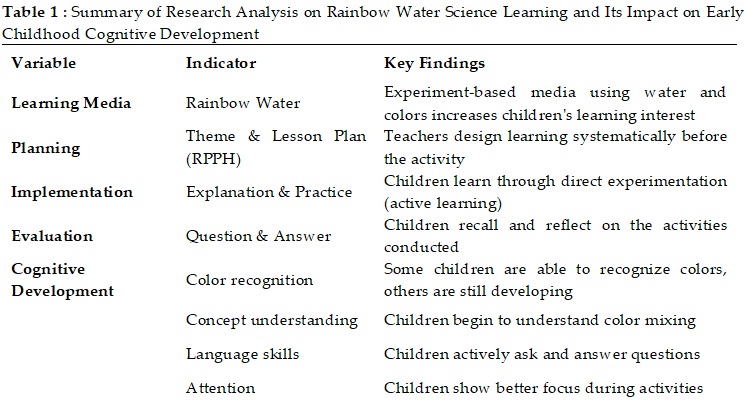
This study examines the implementation of Rainbow Water science learning media and its impact on the cognitive development of children aged 3–4 years at KB Al Azhar Gresik. Using a qualitative descriptive design with a naturalistic approach, data were collected through participatory observation, in-depth interviews, and documentation involving the principal, teachers, and students. Data analysis followed the Miles and Huberman model, including data collection, reduction, display, and conclusion drawing, while validity was ensured through triangulation. The findings indicate that Rainbow Water serves as an effective experiential learning medium that stimulates children’s cognitive development through direct experimentation and interaction. The implementation involves structured stages, including theme determination, preparation of materials, guided activities, and evaluation. Children showed progressive cognitive improvement, particularly in recognizing colors, responding to questions, and demonstrating better attention and behavioral control. Additionally, the activity fosters basic scientific thinking skills such as observing, predicting, and understanding cause-and-effect relationships. The study also reveals that children’s enthusiasm supports learning engagement, although challenges in self-regulation remain. Supporting factors include teacher collaboration and adequate facilities. Overall, this study reinforces constructivist theory and highlights the importance of innovative, experience-based learning in optimizing early childhood cognitive development.
References
Abdulhameed, S., & Rashid, T. A. (2022). Child Drawing Development Optimization Algorithm Based on Child’s Cognitive Development. Arabian Journal for Science and Engineering, 47(2), 1337–1351. https://doi.org/10.1007/s13369-021-05928-6
Allaire, J. C., & Marsiske, M. (1999). Everyday cognition: Age and intellectual ability correlates. Psychology and Aging, 14(4), 627–644. https://doi.org/10.1037/0882-7974.14.4.627
Andersson, O. (2012). Experiment!: Planning, Implementing and Interpreting. John Wiley & Sons.
Arif, M. (2023). Karya Tulis Ilmiah: Implementasi Chatgpt Dan Manajemen Referensi Menulis. PT. Sonpedia Publishing Indonesia.
Arif, M. (2025). A recent study on islamic religious education teachers’ competencies in the digital age: A systematic literature review. Journal of Education and Learning, 19(2), 587–596. https://doi.org/10.11591/edulearn.v19i2.21311
Arif, M., Munfa’ati, K., & Kalimatusyaroh, M. (2021). Homeroom Teacher Strategy in Improving Learning Media Literacy during Covid-19 Pandemic. Madrasah, 13(2), 126–141. https://doi.org/10.18860/mad.v13i2.11804
Barnes, B. (2013). Scientific knowledge and sociological theory. Routledge. https://api.taylorfrancis.com/content/books/mono/download?identifierName=doi&identifierValue=10.4324/9780203706541&type=googlepdf
Bennett, A. (2006). Qualitative research: Recent developments in case study methods. Annual Review of Political Science, 9(Query date: 2025-07-30 18:54:59), 455–476. https://doi.org/10.1146/annurev.polisci.8.082103.104918
Beroukhim, G., Esencan, E., & Seifer, D. B. (2022). Impact of sleep patterns upon female neuroendocrinology and reproductive outcomes: A comprehensive review. Reproductive Biology and Endocrinology, 20(1), 16. https://doi.org/10.1186/s12958-022-00889-3
Birney, D. P., Citron-Pousty, J. H., Lutz, D. J., & Sternberg, R. J. (2005). The Development of Cognitive and Intellectual Abilities. In Developmental science: An advanced textbook, 5th ed (pp. 327–358). Lawrence Erlbaum Associates Publishers.
Brunet, V., Lafond, T., Kleiber, A., Lansade, L., Calandreau, L., & Colson, V. (2023). Environmental enrichment improves cognitive flexibility in rainbow trout in a visual discrimination task: First insights. Frontiers in Veterinary Science, 10. https://doi.org/10.3389/fvets.2023.1184296
Cadwell, L. B. (2003). Bringing Learning to Life: The Reggio Approach to Early Childhood Education. Teachers College Press.
Catherine, L., Javier, B., & Francisco, G. (2019). Four Pillars of the Montessori Method and Their Support by Current Neuroscience. https://doi.org/10.1111/mbe.12262
Chambers, B., Cheung, A. C. K., & Slavin, R. E. (2016). Literacy and language outcomes of comprehensive and developmental-constructivist approaches to early childhood education: A systematic review. Educational Research Review, 18, 88–111. https://doi.org/10.1016/j.edurev.2016.03.003
Chen, P. (2015). Using service design tool and qualitative research method to assist the e-government service process redesign: A case study of the taxation service process in Taiwan. Pacific Asia Conference on Information Systems Pacis 2015 Proceedings, (Query date: 2025-07-30 18:54:59). https://www.scopus.com/inward/record.uri?partnerID=HzOxMe3b&scp=85011019578&origin=inward
Cherukunnath, D., & Singh, A. P. (2022). Exploring Cognitive Processes of Knowledge Acquisition to Upgrade Academic Practices. Frontiers in Psychology, 13. https://doi.org/10.3389/fpsyg.2022.682628
Correia, N., Camilo, C., Aguiar, C., & Amaro, F. (2019). Children’s right to participate in early childhood education settings: A systematic review. Children and Youth Services Review, 100, 76–88. https://doi.org/10.1016/j.childyouth.2019.02.031
Desta, S. Z., Gedefaw, S. T., Tefera, D. E., Abate, S. G., & Ayenalem, K. A. (2023). The status of teachers’ collaboration in Ethiopian public universities found in the Amhara region. Heliyon, 9(1). https://doi.org/10.1016/j.heliyon.2023.e12848
Dewanti, B. A. (2022). Comparing Student Creativity Skills in Experiment-Based and Project-Based Science Learning. Prisma Sains : Jurnal Pengkajian Ilmu Dan Pembelajaran Matematika Dan IPA IKIP Mataram, 10(3), 786–794. https://doi.org/10.33394/j-ps.v10i3.5348
Dodgson, J. E. (2017). About research: Qualitative methodologies. Journal of Human Lactation, 33(2), 355–358.
Gea, J. J., Diana, D., & Aeni, K. (2025). Holistic-Integrative Early Childhood Education and Its Impact on Social-Emotional, Physical, and Cognitive Development: A Multi-Regional Regression Analysis. Golden Age: Jurnal Ilmiah Tumbuh Kembang Anak Usia Dini, 10(1), 163–171. https://doi.org/10.14421/jga.2025.101-13
Guillory, J. (2010). Genesis of the Media Concept. Critical Inquiry, 36(2), 321–362. https://doi.org/10.1086/648528
Habeeb, K. M., Alnajjar, A. M., & Jafer, Y. (2024). Effects of an interdisciplinary approach in science and arts on cognitive development of kindergarten children. Education 3-13, 0(0), 1–12. https://doi.org/10.1080/03004279.2024.2406417
Haq, A. M., & Roesminingsih, E. (2024). Situational Leadership Skills of Foundation Heads in Human Resource Development for Early Childhood Education. Munaddhomah: Jurnal Manajemen Pendidikan Islam, 5(1), 26–40. https://doi.org/10.31538/munaddhomah.v5i1.545
Hewett, V. M. (2001). Examining the Reggio Emilia Approach to Early Childhood Education. Early Childhood Education Journal, 29(2), 95–100. https://doi.org/10.1023/A:1012520828095
Hsu, Y.-S. (2006). ‘Lesson Rainbow’: The use of multiple representations in an Internet-based, discipline-integrated science lesson. British Journal of Educational Technology, 37(4), 539–557. https://doi.org/10.1111/j.1467-8535.2006.00551.x
Jacob, E. (1989). Qualitative Research: A Defense of Traditions - Evelyn Jacob, 1989. Sage Journals. https://journals.sagepub.com/doi/abs/10.3102/00346543059002229
Jafarov, S. (2023). Synergetic and innovative approaches to education. Revista de Investigaciones Universidad Del Quindío, 35(1), 415–430. https://doi.org/10.33975/riuq.vol35n1.1191
Keil, F. C. (1981). Constraints on knowledge and cognitive development. Psychological Review, 88(3), 197–227. https://doi.org/10.1037/0033-295X.88.3.197
Khan, F., & Singh, K. (2015). Curricular Improvements through Computation and Experiment Based Learning Modules. Advances in Engineering Education, 4(4). https://eric.ed.gov/?id=EJ1077840
Kleebbua, C., & Siriparp, T. (2016). Effects of Education and Attitude on Essential Learning Outcomes. Procedia - Social and Behavioral Sciences, Future Academy Multidisciplinary Conference “ICEEPSY & CPSYC & icPSIRS & BE-Ci” 13–17 October 2015 Istanbul, 217, 941–949. https://doi.org/10.1016/j.sbspro.2016.02.061
Lange, G., & Pierce, S. H. (1992). Memory-strategy learning and maintenance in preschool children. Developmental Psychology, 28(3), 453–462. https://doi.org/10.1037/0012-1649.28.3.453
Leavy, P. (2020). The Oxford Handbook of Qualitative Research. Oxford University Press.
Lubis, L. H., Febriani, B., Yana, R. F., Azhar, A., & Darajat, M. (2023). The Use of Learning Media and its Effect on Improving the Quality of Student Learning Outcomes. International Journal Of Education, Social Studies, And Management (IJESSM), 3(2), 7–14. https://doi.org/10.52121/ijessm.v3i2.148
Mariyono, D. (2024). Indonesian mosaic: The essential need for multicultural education. Quality Education for All, 1(1), 301–325. https://doi.org/10.1108/QEA-05-2024-0042
Mayra, Z., Maulana, M. N., & Kushendar, K. (2022). The Effect of Emotional Social Development on Physical Motor Development in Early Childhood. Journal of Childhood Development, 2(2), 64–70. https://doi.org/10.25217/jcd.v2i2.2693
Mulyenı, T., Jamarıs, M., & Suprıyatı, Y. (2019). Improving basic science process skills through ınquiry-based approach in learning science for early elementary students. Journal of Turkish Science Education, 16(2), 187–201.
Okokoyo Isabella Ezinwa, P. (2024). The Role of Teacher-Student Relationships in Classroom Management and Student Engagement. JALINGO JOURNAL OF SOCIAL AND MANAGEMENT SCIENCES, 6(1), 234–246.
Pangestu, A. M. D. (2025). Stimulation Program to Enhance Optimal Development in Early Childhood (case Study of Developmental Assessment of 3-Year-Old Children). Tunas Cendekia : Jurnal Program Studi Pendidikan Anak Usia Dini, 8(1), 29–40. https://doi.org/10.24256/tunascendekia.v8i1.5619
Pell, T., & Jarvis, T. (2001). Developing attitude to science scales for use with children of ages from five to eleven years. International Journal of Science Education, 23(8), 847–862. https://doi.org/10.1080/09500690010016111
Politi, A. (2023). Maria Montessori: A Visionary Whose Insights Align With Neuroscience. Cortica, 2(2), 203–222. https://doi.org/10.26034/cortica.2023.4218
Puspitarini, Y. D., & Hanif, M. (2019). Using Learning Media to Increase Learning Motivation in Elementary School. Anatolian Journal of Education, 4(2), 53–60.
Raheef, O. O. (2024). Facilities Availability to Support Teaching and Learning Process and Public Reactions Toward Technical Education. ETDC: Indonesian Journal of Research and Educational Review, 3(3), 71–83. https://doi.org/10.51574/ijrer.v3i3.1528
Rohimat, S. (2022). Experiment-based Learning in The Topic of Natural Acid-Base Indicators During A Limited Face-to-face Learning Process. Indonesian Journal of Mathematics and Natural Science Education, 3(1), 43–52. https://doi.org/10.35719/mass.v3i1.86
Rohwer, W. (1971). Prime Time for Education: Early Childhood or Adolescence? Harvard Educational Review, 41(3), 316–341. https://doi.org/10.17763/haer.41.3.f806664045531377
Salway, R., Foster, C., de Vocht, F., Tibbitts, B., Emm-Collison, L., House, D., Williams, J. G., Breheny, K., Reid, T., Walker, R., Churchward, S., Hollingworth, W., & Jago, R. (2022). Accelerometer-measured physical activity and sedentary time among children and their parents in the UK before and after COVID-19 lockdowns: A natural experiment. International Journal of Behavioral Nutrition and Physical Activity, 19(1), 51. https://doi.org/10.1186/s12966-022-01290-4
Schneider, W., Visé, M., Lockl, K., & Nelson, T. O. (2000). Developmental trends in children’s memory monitoring: Evidence from a judgment-of-learning task. Cognitive Development, 15(2), 115–134. https://doi.org/10.1016/S0885-2014(00)00024-1
Sher, K., & Inamullah, P. D. H. M. (2025). Building a Supportive Learning Environment: A Qualitative Study on Conducive School Culture in Public Secondary Schools. Social Science Review Archives, 3(2), 1939–1946. https://doi.org/10.70670/sra.v3i2.812
Silva, L., Mendes, A., Gomes, A., & Fortes, G. (2024). What Learning Strategies are Used by Programming Students? A Qualitative Study Grounded on the Self-regulation of Learning Theory. ACM Trans. Comput. Educ., 24(1), 9:1-9:26. https://doi.org/10.1145/3635720
Siraj, S., Nasrah, S., & Trisfayani, T. (2019). The System Approach in the Perspective of Law Number 20 of 2003 concerning the National Education System. International Journal for Educational and Vocational Studies, 1(1), 47–52. https://doi.org/10.29103/ijevs.v1i1.1465
Sowmya, A. S. L., & Rani, R. N. (2025). Emerging interest in science during early childhood period and evaluating its effectiveness. Scientific Reports, 15(1), 38683. https://doi.org/10.1038/s41598-025-22513-1
Tanco, M., Viles, E., Ilzarbe, L., & Alvarez, M. J. (2009). Implementation of Design of Experiments projects in industry. Applied Stochastic Models in Business and Industry, 25(4), 478–505. https://doi.org/10.1002/asmb.779
Tolmie, A. K., Ghazali, Z., & Morris, S. (2016). Children’s science learning: A core skills approach. British Journal of Educational Psychology, 86(3), 481–497. https://doi.org/10.1111/bjep.12119
Vella-Brodrick, D. A., & Gilowska, K. (2022). Effects of Nature (Greenspace) on Cognitive Functioning in School Children and Adolescents: A Systematic Review. Educational Psychology Review, 34(3), 1217–1254. https://doi.org/10.1007/s10648-022-09658-5
Wang, C., Shirzaei Sani, E., Shih, C.-D., Lim, C. T., Wang, J., Armstrong, D. G., & Gao, W. (2024). Wound management materials and technologies from bench to bedside and beyond. Nature Reviews Materials, 9(8), 550–566. https://doi.org/10.1038/s41578-024-00693-y
Widodo, S. A., & Wahyudin. (2018). Selection of Learning Media Mathematics for Junior School Students. Turkish Online Journal of Educational Technology - TOJET, 17(1), 154–160.
Yulianis, N., Maswar, R., & Dahliana, D. (2025). Evaluation of Early Childhood Physical-Motor Development in the Perspective of Child Development Achievement Standards. Bunayya: Journal of Islamic Early Childhood Education, 1(1), 7–14.
Zahrah, F., & Winarti, W. (2024). Identifying Early Childhood Science Process Skills Through Color Mixing Experimental Activities. Journal of Childhood Development, 4(2), 441–449. https://doi.org/10.25217/jcd.v4i2.5074
Zhou, H. (2025). Exploring the dynamic teaching-learning relationship in interactive learning environments. Interactive Learning Environments, 33(7), 4363–4393. https://doi.org/10.1080/10494820.2025.2462149
Downloads
Published
Issue
Section
License
Copyright (c) 2026 Firdausi Nuzula Apriliyana, Ika Irayana

This work is licensed under a Creative Commons Attribution-ShareAlike 4.0 International License.