Integrating Science Literacy in Elementary Education: Teachers’ Perspectives and Practices in a Rural Indonesian Madrasah
Keywords:
Science literacy; Teachers’ perspective; Elementary education; Madrasah Ibtidaiyah; Inquiry-based learning; PISA framework; Contextual learning.Abstract
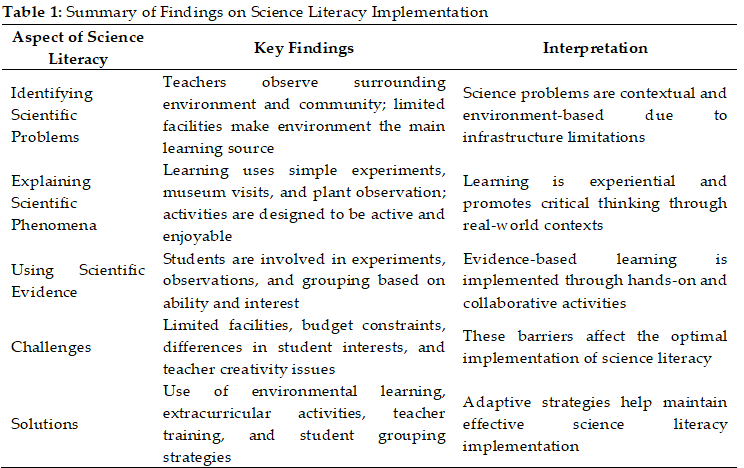
This study investigates teachers’ perspectives in fostering science literacy among students at Madrasah Ibtidaiyah Miftahul Ulum Kesamben Wetan Driyorejo Gresik. The research is grounded in the importance of science literacy as a key competency in 21st-century education, particularly at the elementary level. A qualitative case study approach was employed, with data collected through interviews, observation, and documentation involving the principal, teachers, and students. The findings indicate that science literacy implementation is reflected in three main dimensions: identifying scientific problems, explaining scientific phenomena, and using scientific evidence. In identifying scientific problems, teachers utilize environmental observation and community context due to limited school facilities. In explaining phenomena, students engage in contextual learning activities such as analyzing food content, visiting educational sites, and conducting simple plant experiments, supported by differentiated learning based on student abilities and learning styles. In using scientific evidence, students are actively involved in learning processes that emphasize critical thinking, experimentation, and conclusion drawing through interactive and enjoyable learning experiences. The study concludes that despite infrastructural limitations, teachers effectively integrate science literacy through contextual and experiential learning strategies. These findings contribute to strengthening PISA-based science literacy theory and highlight practical implications for improving elementary science education in resource-limited settings. Further research is recommended to expand the scope across multiple institutions using comparative or mixed-method approaches.
References
Abbas, A. (2023). Earnings growth, marketability and the role of Islamic financial literacy and inclusion in Indonesia. Journal of Islamic Accounting and Business Research, 14(7), 1088–1105. https://doi.org/10.1108/JIABR-12-2021-0322
Abdullah, G. (2024). Utilization of the Surrounding Environment as a Science Learning Resource in Gorontalo Province. Jurnal Penelitian Pendidikan IPA, 10(11), 8482–8489. https://doi.org/10.29303/jppipa.v10i11.8754
Adhi, S. (2022). Developing a blended learning model in islamic religious education to improve learning outcomes. International Journal of Information and Education Technology, 12(2), 100–107. https://doi.org/10.18178/ijiet.2022.12.2.1592
Adiyono, Saraya, A., Mardhatillah, A., & Fitriani, E. N. (2023). Educational Supervision of the Efforts Made Madrasah Family in Mts Al-Ihsan in Increasing the Professionalism of Teachers Teacher Professionalism. Cendekia: Jurnal Pendidikan Dan Pembelajaran, 17(1), Article 1. https://doi.org/10.30957/cendekia.v17i1.815
Aisyah, S., Halida, & Lukmanulhakim. (2024). The Role of Teachers in Shaping Religious Character in Early Childhood through the Habituation Method at Al-Mumtaz IT Kindergarten, Pontianak City. Journal of Early Childhood Development and Education, 1(3), 87–92. https://doi.org/10.58723/junior.v1i3.239
Al Hyari, H. S. (2023). Change Resistance Management And The Transition To Distamce Learning During COVID-19: Moderating Role Of Education Technology. International Journal of Professional Business Review: Int. J. Prof.Bus. Rev., 8(3), 4.
Ali, N. (2021). Interreligious Literacy Learning as a Counter-Radicalization Method: A New Trend among Institutions of Islamic Higher Education in Indonesia. Islam and Christian-Muslim Relations, 32(4), 383–405. https://doi.org/10.1080/09596410.2021.1996978
Alsaleh, N. J. (2020). Teaching Critical Thinking Skills: Literature Review. Turkish Online Journal of Educational Technology - TOJET, 19(1), 21–39.
Arif, M. (2024). The Existence of Madrasah Ibtidaiyah Based on Pesantren: Challenges and Opportunities in The Digital Era. Munaddhomah, 5(4), 367–382. https://doi.org/10.31538/munaddhomah.v5i4.1401
Arifin, M. Z. (2023). Implementation of the Sorogan Method in Improving the Ability to Read the Yellow Book ‘Kitab Kuning’ of Santri at the Sabilunnajah Islamic Boarding School. Journal of Contemporary Islamic Education, 3(1), 59–70.
Budnyk, O., Kachak, T., Blyznyuk, T., Rostykus, N., & Boiko, H. (2021). Printed and e-book: Problems of choice of modern students of the university. Revista Tempos e Espaços Em Educação, 14(33), e15913–e15913. https://doi.org/10.20952/revtee.v14i33.15913
Choi, S. L. (2016). Transformational leadership, empowerment, and job satisfaction: The mediating role of employee empowerment. Human Resources for Health, 14(1). https://doi.org/10.1186/s12960-016-0171-2
Daheri, M. (2022). Religious Moderation, Inclusive, and Global Citizenship as New Directions for Islamic Religious Education in Madrasah. Nazhruna: Jurnal Pendidikan Islam, 5(1), Article 1. https://doi.org/10.31538/nzh.v5i1.1853
Darmawan, B., Wijaya, I. P., & Alhuzaini, M. (2023). Radikalisme dan Intoleransi terhadap Generasi Muda dalam Memanfaatkan Teknologi Era Globalisasi di Indonesia. At-Tajdid : Journal of Islamic Studies, 3(2), Article 2. https://doi.org/10.24014/at-tajdid.v3i2.25512
Dragoş, V., & Mih, V. (2015). Scientific Literacy in School. Procedia - Social and Behavioral Sciences, The 3rd International Conference “EDUCATION, REFLECTION, DEVELOPMENT”, 3th - 4th July, 2015, 209, 167–172. https://doi.org/10.1016/j.sbspro.2015.11.273
Duchan, J. F. (1986). Learning to describe events. Topics in Language Disorders, 6(4), 27.
El-Arini, K., & Guestrin, C. (2011). Beyond keyword search: Discovering relevant scientific literature. Proceedings of the 17th ACM SIGKDD International Conference on Knowledge Discovery and Data Mining, KDD ’11, 439–447. https://doi.org/10.1145/2020408.2020479
Elhai, J. (2023). Science Literacy: A More Fundamental Meaning. Journal of Microbiology & Biology Education, 24(1), e00212-22. https://doi.org/10.1128/jmbe.00212-22
Fazey, I., Fazey, J. A., & Fazey, D. M. A. (2005). Learning More Effectively from Experience. Ecology and Society, 10(2). https://www.jstor.org/stable/26267749
Fortus, D., Lin, J., Neumann, K., & Sadler, T. D. (2022). The role of affect in science literacy for all. International Journal of Science Education, 44(4), 535–555. https://doi.org/10.1080/09500693.2022.2036384
Goodman, S. N., & Royall, R. (1988). Evidence and scientific research. American Journal of Public Health, 78(12), 1568–1574. https://doi.org/10.2105/AJPH.78.12.1568
Gormezano, I., & Kehoe, E. J. (1975). Classical conditioning: Some methodological-conceptual issues. Handbook of Learning and Cognitive Processes, 2, 143–179.
Heffernan, K., & Teufel, S. (2018). Identifying problems and solutions in scientific text. Scientometrics, 116(2), 1367–1382. https://doi.org/10.1007/s11192-018-2718-6
Holbrook, J., & Rannikmae, M. (2007). The Nature of Science Education for Enhancing Scientific Literacy. International Journal of Science Education, 29(11), 1347–1362. https://doi.org/10.1080/09500690601007549
Jufrida, J., Basuki, F. R., Kurniawan, W., Pangestu, M. D., & Fitaloka, O. (2019). Scientific Literacy and Science Learning Achievement at Junior High School. International Journal of Evaluation and Research in Education, 8(4), 630–636.
Kimonen, E., & Nevalainen, R. (2005). Active learning in the process of educational change. Teaching and Teacher Education, 21(6), 623–635. https://doi.org/10.1016/j.tate.2005.05.003
Lanny, P. D. M., Andriana, E., & Yuliana, R. (2024). Teacher Creativity in Implementing Enjoyable Learning at Sd Cilenggang 2 South Tangerang City. JPSD (Jurnal Pendidikan Sekolah Dasar), 10(2), 108–115. https://doi.org/10.30870/jpsd.v10i2.26009
Liu, Y., Chen, L., & Yao, Z. (2022). The application of artificial intelligence assistant to deep learning in teachers’ teaching and students’ learning processes. Frontiers in Psychology, 13. https://doi.org/10.3389/fpsyg.2022.929175
Maarif, M., Rofiq, M., & Sirojuddin, A. (2022). Implementing learning strategies for moderate Islamic religious education in Islamic higher education. Jurnal Pendidikan Islam, 8(1), 75–86. https://doi.org/10.15575/jpi.v8i1.19037
Malik, R. S. (2018). Educational Challenges in 21st Century and Sustainable Development. Journal of Sustainable Development Education and Research, 2(1), 9–20. https://doi.org/10.17509/jsder.v2i1.12266
Manalu, E. W. R. (2024). Enhancing Active, Innovative, Creative, Effective, and Enjoyable Learning in Information and Communication Technology Subjects. Jurnal Pendidikan Vokasi Indonesia, 3(01), 23–27. https://doi.org/10.63401/jpvi.v3i01.142
McCain, K. (2015). Explanation and the Nature of Scientific Knowledge. Science & Education, 24(7), 827–854. https://doi.org/10.1007/s11191-015-9775-5
McFarlane, D. A. (2013). Understanding the Challenges of Science Education in the 21st Century: New Opportunities for Scientific Literacy. International Letters of Social and Humanistic Sciences, (04), 35–44.
Nyambane, R. (2021). The future of the printed book in the era of technological advancement: An imperative for digital innovation and engagement. Journal of Information, Communication and Ethics in Society, 19(4), 537–559. https://doi.org/10.1108/JICES-10-2020-0106
Osborne, J. (2023). Science, Scientific Literacy, and Science Education. In Handbook of Research on Science Education. Routledge.
Patton, M. Q. (2015). Qualitative research & evaluation methods: Integrating theory and practice (Fourth edition). SAGE Publications, Inc.
Pelley, J. (2014). Making Active Learning Effective. Medical Science Educator, 24(1), 13–18. https://doi.org/10.1007/s40670-014-0087-1
Persky, A. M., Medina, M. S., & Castleberry, A. N. (2019). Developing Critical Thinking Skills in Pharmacy Students. American Journal of Pharmaceutical Education, 83(2), 7033. https://doi.org/10.5688/ajpe7033
Prasetyono, H., Abdillah, A., Djuhartono, T., Ramdayana, I. P., & Desnaranti, L. (2021). Improvement of Teacher’s Professional Competency in Strengthening Learning Methods to Maximize Curriculum Implementation. International Journal of Evaluation and Research in Education, 10(2), 720–727.
Qolbiyah, A., Sonzarni, S., & Ismail, M. A. (2022). Implementation of the Independent Learning Curriculum at the Driving School. Jurnal Penelitian Ilmu Pendidikan Indonesia, 1(1), Article 1. https://doi.org/10.31004/jpion.v1i1.1
Rahmayanti, J. D., & Arif, M. (2021). Penerapan Full Day School Dalam Mengembangkan Budaya Religius di Sekolah Dasar Muhammadiyah 1 Menganti Gresik. EL Bidayah: Journal of Islamic Elementary Education, 3(1), 11–31.
Roberts, D. A., & Bybee, R. W. (2014). Scientific Literacy, Science Literacy, and Science Education. In Handbook of Research on Science Education, Volume II. Routledge.
Robinson, C. F., & Kakela, P. J. (2006). Creating a Space to Learn: A Classroom of Fun, Interaction, and Trust. College Teaching, 54(1), 202–207. https://doi.org/10.3200/CTCH.54.1.202-207
Rokhmah, D. (2020). Knowledge, attitude, and behaviour about healthy snacks selection with health literacy in primary school students at the rural area. IOP Conference Series: Earth and Environmental Science, 485(1). https://doi.org/10.1088/1755-1315/485/1/012029
Şahin, M. (2007). The Importance of Efficiency in Active Learning. Journal of Turkish Science Education, 4(2), 61–74.
Salimi, M. (2021). The profile of students’ eco-literacy at nature primary school. Cypriot Journal of Educational Sciences, 16(4), 1450–1470. https://doi.org/10.18844/cjes.v16i4.5999
Shah, P. K., Perez-Iratxeta, C., Bork, P., & Andrade, M. A. (2003). Information extraction from full text scientific articles: Where are the keywords? BMC Bioinformatics, 4(1), 20. https://doi.org/10.1186/1471-2105-4-20
Sjöström, J., & Eilks, I. (2018). Reconsidering Different Visions of Scientific Literacy and Science Education Based on the Concept of Bildung. In Y. J. Dori, Z. R. Mevarech, & D. R. Baker (Eds.), Cognition, Metacognition, and Culture in STEM Education: Learning, Teaching and Assessment (pp. 65–88). Springer International Publishing. https://doi.org/10.1007/978-3-319-66659-4_4
Sklar, L. (2014). Physical Theory: Method and Interpretation. Oxford University Press.
Smith, K. V., Loughran, J., Berry, A., & Dimitrakopoulos, C. (2012). Developing Scientific Literacy in a Primary School. International Journal of Science Education, 34(1), 127–152. https://doi.org/10.1080/09500693.2011.565088
Souto-Otero, M. (2012). Learning outcomes: Good, irrelevant, bad or none of the above? Journal of Education and Work, 25(3), 249–258. https://doi.org/10.1080/13639080.2012.689648
Subairi, A. (2025). Learning Innovation: Creating an Effective and Enjoyable Learning Model in Elementary Madrasahs. MSJ : Majority Science Journal, 3(1), 154–162. https://doi.org/10.61942/msj.v3i1.300
Tang, A. L. L., Walker-Gleaves, C., & Rattray, J. (2021). University students’ conceptions and experiences of teacher care amidst online learning. Teaching in Higher Education, 29(2), 366–387. https://doi.org/10.1080/13562517.2021.1989579
Turiman, P., Omar, J., Daud, A. M., & Osman, K. (2012). Fostering the 21st Century Skills through Scientific Literacy and Science Process Skills. Procedia - Social and Behavioral Sciences, Universiti Kebangsaan Malaysia Teaching and Learning Congress 2011, Volume I, December 17 – 20 2011, Pulau Pinang MALAYSIA, 59, 110–116. https://doi.org/10.1016/j.sbspro.2012.09.253
Winarni, E. W., Karpudewan, M., Karyadi, B., & Gumono, G. (2022). Integrated PjBL-STEM in Scientific Literacy and Environment Attitude for Elementary School. Asian Journal of Education and Training, 8(2), 43–50.
Yin, R. K. (2018). Case study research and applications: Design and methods (Sixth edition). SAGE.
Downloads
Published
Issue
Section
License
Copyright (c) 2026 Kusnul Munfa'ati, Khamidatur Rahmah, Mei Kalimatusyaro

This work is licensed under a Creative Commons Attribution-ShareAlike 4.0 International License.