Developing Environmental Literacy through Project-Based Learning: Insights from Islamic Elementary Education
Keywords:
Project-Based Learning (PjBL), environmental cleanliness, student engagement, conceptual understanding, environmental awareness, Madrasah Ibtidaiyah,Abstract
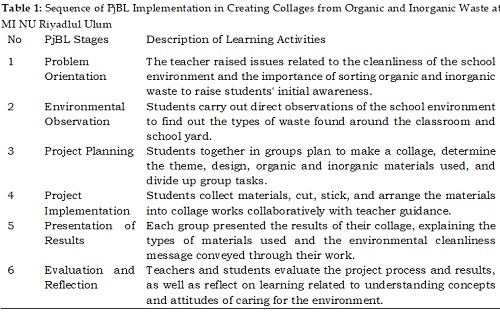
This study aims to examine the implementation and effectiveness of Project-Based Learning (PjBL) in improving students’ engagement, conceptual understanding, skills, and environmental awareness in environmental cleanliness material at the fourth-grade level of Madrasah Ibtidaiyah (MI) NU Riyadlul Ulum. Employing a qualitative descriptive approach, the research involved teachers and students as participants, with data collected through observation, interviews, and documentation. The findings reveal that the implementation of PjBL through a contextual collage-making project using organic and inorganic materials was carried out systematically and effectively. Students actively participated in all learning stages, including environmental observation, project planning, collaborative work, and presentation, which significantly enhanced their engagement and learning motivation. The results indicate improvements in students’ conceptual understanding, creativity, collaboration, psychomotor skills, and attitudes toward environmental responsibility. These findings are consistent with constructivist and social constructivist theories, highlighting the importance of active, collaborative, and experiential learning processes. Moreover, the teacher’s role as a facilitator and guide was crucial in ensuring the success of the learning process. Despite its positive outcomes, the study is limited to a single classroom context, which may affect generalizability. Therefore, further research employing broader samples and mixed-method approaches is recommended. Overall, PjBL is demonstrated to be an effective pedagogical strategy for fostering meaningful and holistic learning in environmental education at the primary level.
References
Ardoin, N. M., Bowers, A. W., & Gaillard, E. (2020). Environmental education outcomes for conservation: A systematic review. Journal of Environmental Education, 51(1), 1–17. https://doi.org/10.1080/00958964.2019.1687404
Barron, B., & Darling-Hammond, L. (2021). Teaching for meaningful learning: A review of inquiry- and project-based learning. Jossey-Bass.
Bell, S. (2010). Project-based learning for the 21st century: Skills for the future. Thinking Skills and Creativity, 5(2), 39–43. https://doi.org/10.1016/j.tsc.2010.01.002
Buck Institute for Education. (2018). Project based learning handbook. PBLWorks. https://www.pblworks.org
Hattie, J. (2009). Visible learning: A synthesis of over 800 meta-analyses relating to achievement. Routledge.
Hosnan, M. (2019). Pendekatan saintifik dan kontekstual dalam pembelajaran abad 21. Ghalia Indonesia.
Johnson, E. B. (2019). Contextual teaching and learning: Connecting learning to life. Corwin Press.
Kemendikbud Ristek RI. (2022). Panduan pembelajaran dan asesmen Kurikulum Merdeka jenjang sekolah dasar. Kementerian Pendidikan, Kebudayaan, Riset, dan Teknologi.
Kokotsaki, D., Menzies, V., & Wiggins, A. (2016). Project-based learning: A review of the literature. Improving Schools, 19(3), 267–277. https://doi.org/10.1177/1365480216659733
Kolb, D. A. (2019). Experiential learning: Experience as the source of learning and development (2nd ed.). Pearson Education.
OECD. (2020). The OECD learning compass 2030. OECD Publishing. https://www.oecd.org
Putri, R. A., & Syahputra, E. (2021). Pembelajaran aktif dan pengaruhnya terhadap pemahaman konsep siswa sekolah dasar. Jurnal Pendidikan Dasar, 12(2), 145–154.
Ridayanti, L., & Meidawaty, S. (2021). Pengembangan kreativitas siswa sekolah dasar melalui kegiatan kolase berbasis proyek. Jurnal Pendidikan Seni dan Kreativitas, 9(1), 33–42.
Rusman. (2021). Model-model pembelajaran: Mengembangkan profesionalisme guru (Edisi revisi). Rajawali Pers.
Slavin, R. E. (2020). Educational psychology: Theory and practice (13th ed.). Pearson Education.
Sudjana, N. (2020). Penilaian hasil proses belajar mengajar (Edisi revisi). PT Remaja Rosdakarya.
Thomas, J. W. (2020). Project-based learning: A handbook for teachers. Buck Institute for Education.
Trianto. (2020). Model pembelajaran terpadu: Konsep, strategi, dan implementasinya. Bumi Aksara.
Vygotsky, L. S. (1978). Mind in society: The development of higher psychological processes. Harvard University Press.
West, M. (2020). Creative collage and mixed media techniques. Thames & Hudson.
Wena, M. (2016). Strategi pembelajaran inovatif kontemporer. Bumi Aksara.
Wena, M. (2021). Strategi pembelajaran inovatif kontemporer. Bumi Aksara.
Downloads
Published
Issue
Section
License
Copyright (c) 2026 Marcella Alfiana, Firdah Nailil Karimah, Khobsa, Shofiyah, Dhurotul Farihah

This work is licensed under a Creative Commons Attribution-ShareAlike 4.0 International License.